
Former tribal trade route highlighted with educational signage, future site of historical marker
GRAND RAPIDS – More than 200 years ago, members of the Grand River Bands of Ottawa Indians carried goods to trade over a 10-mile footpath that linked their villages with those at the confluence of the Grand and Thornapple rivers.
The footpath ran along what is today Fulton Street, Lake Drive and Robinson Road. After local historians learned about the rich history of the area, the significance of this critical trade route is being recognized through educational signage and, eventually, a Michigan Historical Marker.
“The Grand River Bands have a long and storied history in West Michigan, and we are looking forward to the recognition of this site, which is an important part of history,” said Ron Yob, chairman of the Grand River Bands. “I’m grateful to our partner organizations on this effort and am excited to share this part of our history with the community.”
The foot path was used to transport goods produced by Ottawa farmers and hunters. In the 1800s, there was a trading post located on the path where Eastown is today. In 1931, city workers dug up human remains and funerary objects associated with the Grand River Bands in Wilcox Park, located a couple blocks east of the convergence of Robinson Road and Lake Drive.
Steve Staggs, program coordinator at the Eastown Community Association (ECA) and professional historian, brought the idea to memorialize the footpath to the Association’s Board of Directors. Partnering with the Grand River Bands, the ECA received funding for the effort by Experience GR through its Discover Tourism Grant Program.
The program helps fund projects that improve local neighborhoods, benefit residents and attract tourists.
“The Eastown Community Association is incredibly proud to help highlight the historical significance of the area and recognize the longtime importance of the Grand River Bands of Ottawa Indians in our community,” Staggs said. “We’re honored to partner with the tribe and showcase its connection to our neighborhood so future generations can continue to learn about our local history.”
On Saturday, Oct. 11, the ECA invited neighbors and tribal members to participate in the Plaster Creek Stewards annual Community Planting Day, where attendees planted native plants provided by Plaster Creek Stewards in the large circular planter at the corner of Lake Drive and Robinson Road. The sign and marker will also be installed in this planter.
The interpretive sign details the historical significance of the area and will provide information to visitors so they can learn more about the Grand River Bands and the tribe’s advocacy for federal recognition.
The Grand River Bands have advocated for federal recognition for more than three decades, first filing a notice to petition with the U.S. Bureau of Indian Affairs Office of Federal Acknowledgement in 1994. The tribe continues to work with officials on the administrative acknowledgement process.
At the same time, the tribe is working with members of Congress on bills in the U.S. House and Senate that would reaffirm federal acknowledgement. Recognition would give members access to important resources including social services, education, housing, elder care and the ability to exercise treaty rights, benefits that are only afforded to federally recognized tribes.
The Grand River Bands and Eastown Community Association will hold an event to unveil the interpretive sign at 6:30 p.m. Monday, Oct. 27 at 1405 Robinson Road SE. In November, the Michigan Historical Commission will meet to consider language for the historical marker that will be installed in the same area.
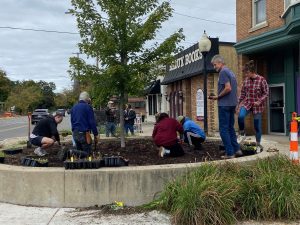
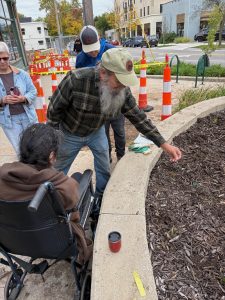
Photos of community planting day and Chairman Ron Yob courtesy of Eastown Community Association
# # #
The Grand River Bands of Ottawa Indians is a native sovereign nation with agreements with the federal government dating back to 1795. The Grand River Bands originally included 19 bands of Ottawa people who lived along the Grand River and other waterways in southwest Michigan. Most of the Grand River Bands’ current membership resides in Kent, Muskegon and Oceana counties.