
The traditional Native American snow snake game challenges players to launch handmade wooden “snakes” down a snow track to see whose can travel the furthest.
Category: In The News
Snow Snake competition held at World of Winter in Grand Rapids
Grand River Bands of Ottawa Indians hosting Great Lakes Snow Snake competition
Compete for $500 prize in traditional Native American game

GRAND RAPIDS – For the fourth consecutive year, the Grand River Bands of Ottawa Indians is hosting a traditional northern Native American game during the World of Winter festival.
The tribe is inviting the Great Lakes community to participate in the fun, family-friendly Great Lakes Snow Snake Competition, taking place on Saturday, Feb. 28. Snow Snake is a game during which a player throws a handmade, wooden “snake” down a snow trough to see who can launch it the farthest.
“The Grand River Bands of Ottawa Indians is excited to welcome competitors back to the Snow Snake Competition and to share part of our culture with our community,” said Ron Yob, chairman of the Grand River Bands. “This is a great event for those interested in learning a new skill and competing alongside members of more than a dozen tribes and is also an entertaining competition to watch.”
Those who wish to compete must make their own snow snake.
Competitors of all ages are welcome, and participants will be split between brackets based on age and gender. Registration begins at 11 a.m. at Sixth Street Park, 647 Monroe Ave. NW. Snow snakes may be available to practice with before the event, though all competitors must make their own snow snakes to compete. The competition at Sixth Street Park begins at noon and is free for participants and spectators.
The Grand River Bands will award a $500 cash prize to the competitor who throws their snow snake the farthest throughout the whole competition. Bracket victories will be awarded $50 prizes.
World of Winter is the largest winter festival in the United States and is taking place through March 1, featuring art installations, events and unique experiences in Downtown Grand Rapids. For more information about the Great Lakes Snow Snake Competition, visit the World of Winter website.
Embracing Our Elders’ Wisdom
Kaitlin Curtice shares her experience visiting burial mounds in Grand Rapids with Chairman Ron Yob.
2026 Great Lakes Snow Snake Competition is Feb. 28
Join us for a Snow Snake Competition on Feb. 28! Snow Snake is a traditional northern Native American game. The snake that is thrown the farthest down a snow trough wins.
Full details available on the World of Winter website.


‘Our history:’ Why the Grand River Burial Mounds are more than a protected site
The Grand River Burial Mounds have been around for roughly 2,000 years and stand as one of the most well-preserved sites of Hopewell Indian culture. For the most part, the mounds stand unmarked and undisturbed, and local Indigenous tribes plan to keep it that way.
How a sprawling plum orchard in Michigan was used by Indigenous women for solace
Hundreds of years ago, Grand Rapids, or Bow-E-Ting (the rapids) in Anishinaabek, was home to a sprawling plum tree orchard utilized by Indigenous women searching for a place of solace.
New sign in Grand Rapids honors thousands of years of Indigenous history
Commemorative marker at Eastown intersection recognizes Grand River Bands of Ottawa Indians’ historical presence and ongoing community ties
Foot path used by Grand River Bands ancestors to be recognized by local groups
Former tribal trade route highlighted with educational signage, future site of historical marker
GRAND RAPIDS – More than 200 years ago, members of the Grand River Bands of Ottawa Indians carried goods to trade over a 10-mile footpath that linked their villages with those at the confluence of the Grand and Thornapple rivers.
The footpath ran along what is today Fulton Street, Lake Drive and Robinson Road. After local historians learned about the rich history of the area, the significance of this critical trade route is being recognized through educational signage and, eventually, a Michigan Historical Marker.
“The Grand River Bands have a long and storied history in West Michigan, and we are looking forward to the recognition of this site, which is an important part of history,” said Ron Yob, chairman of the Grand River Bands. “I’m grateful to our partner organizations on this effort and am excited to share this part of our history with the community.”
The foot path was used to transport goods produced by Ottawa farmers and hunters. In the 1800s, there was a trading post located on the path where Eastown is today. In 1931, city workers dug up human remains and funerary objects associated with the Grand River Bands in Wilcox Park, located a couple blocks east of the convergence of Robinson Road and Lake Drive.
Steve Staggs, program coordinator at the Eastown Community Association (ECA) and professional historian, brought the idea to memorialize the footpath to the Association’s Board of Directors. Partnering with the Grand River Bands, the ECA received funding for the effort by Experience GR through its Discover Tourism Grant Program.
The program helps fund projects that improve local neighborhoods, benefit residents and attract tourists.
“The Eastown Community Association is incredibly proud to help highlight the historical significance of the area and recognize the longtime importance of the Grand River Bands of Ottawa Indians in our community,” Staggs said. “We’re honored to partner with the tribe and showcase its connection to our neighborhood so future generations can continue to learn about our local history.”
On Saturday, Oct. 11, the ECA invited neighbors and tribal members to participate in the Plaster Creek Stewards annual Community Planting Day, where attendees planted native plants provided by Plaster Creek Stewards in the large circular planter at the corner of Lake Drive and Robinson Road. The sign and marker will also be installed in this planter.
The interpretive sign details the historical significance of the area and will provide information to visitors so they can learn more about the Grand River Bands and the tribe’s advocacy for federal recognition.
The Grand River Bands have advocated for federal recognition for more than three decades, first filing a notice to petition with the U.S. Bureau of Indian Affairs Office of Federal Acknowledgement in 1994. The tribe continues to work with officials on the administrative acknowledgement process.
At the same time, the tribe is working with members of Congress on bills in the U.S. House and Senate that would reaffirm federal acknowledgement. Recognition would give members access to important resources including social services, education, housing, elder care and the ability to exercise treaty rights, benefits that are only afforded to federally recognized tribes.
The Grand River Bands and Eastown Community Association will hold an event to unveil the interpretive sign at 6:30 p.m. Monday, Oct. 27 at 1405 Robinson Road SE. In November, the Michigan Historical Commission will meet to consider language for the historical marker that will be installed in the same area.
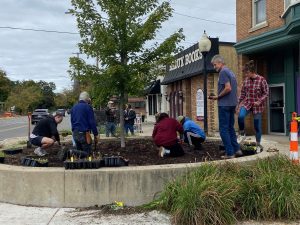
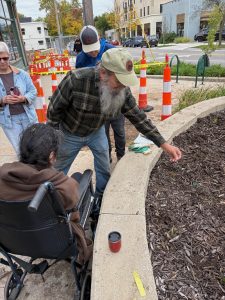
Photos of community planting day and Chairman Ron Yob courtesy of Eastown Community Association
# # #
The Grand River Bands of Ottawa Indians is a native sovereign nation with agreements with the federal government dating back to 1795. The Grand River Bands originally included 19 bands of Ottawa people who lived along the Grand River and other waterways in southwest Michigan. Most of the Grand River Bands’ current membership resides in Kent, Muskegon and Oceana counties.
2025 Adult Duck Race & Ghost Supper
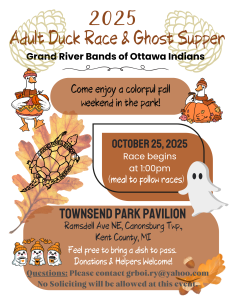
There will also be a Homemade Boat Race after the last Duck Race.
The Boat Race will be for adults 20 years old and above.
Adults must register to enter.
Adults must be present to register.
Adults must be present to win.
Boats must be homemade.
No mechanical powered boats allowed.
Boats must be under 13 inches.